Our Book
A Groundbreaking Resource for an Overlooked Reality
There was a time—not long ago—when even acknowledging the possibility of paranormal experiences could cost someone their credibility, their career, or worse—their sanity in the eyes of others. For professionals in particular, such admissions risked labels like unstable, delusional, or unfit to practice.
But the reality has changed.
Today, more than half of the population reports having experienced something anomalous or unexplained. These are not rare occurrences confined to the margins—they are part of the lived experiences of the very clients mental health professionals serve every day.
And yet, most clinicians were never trained to respond.
Filling the Gap in Clinical Practice
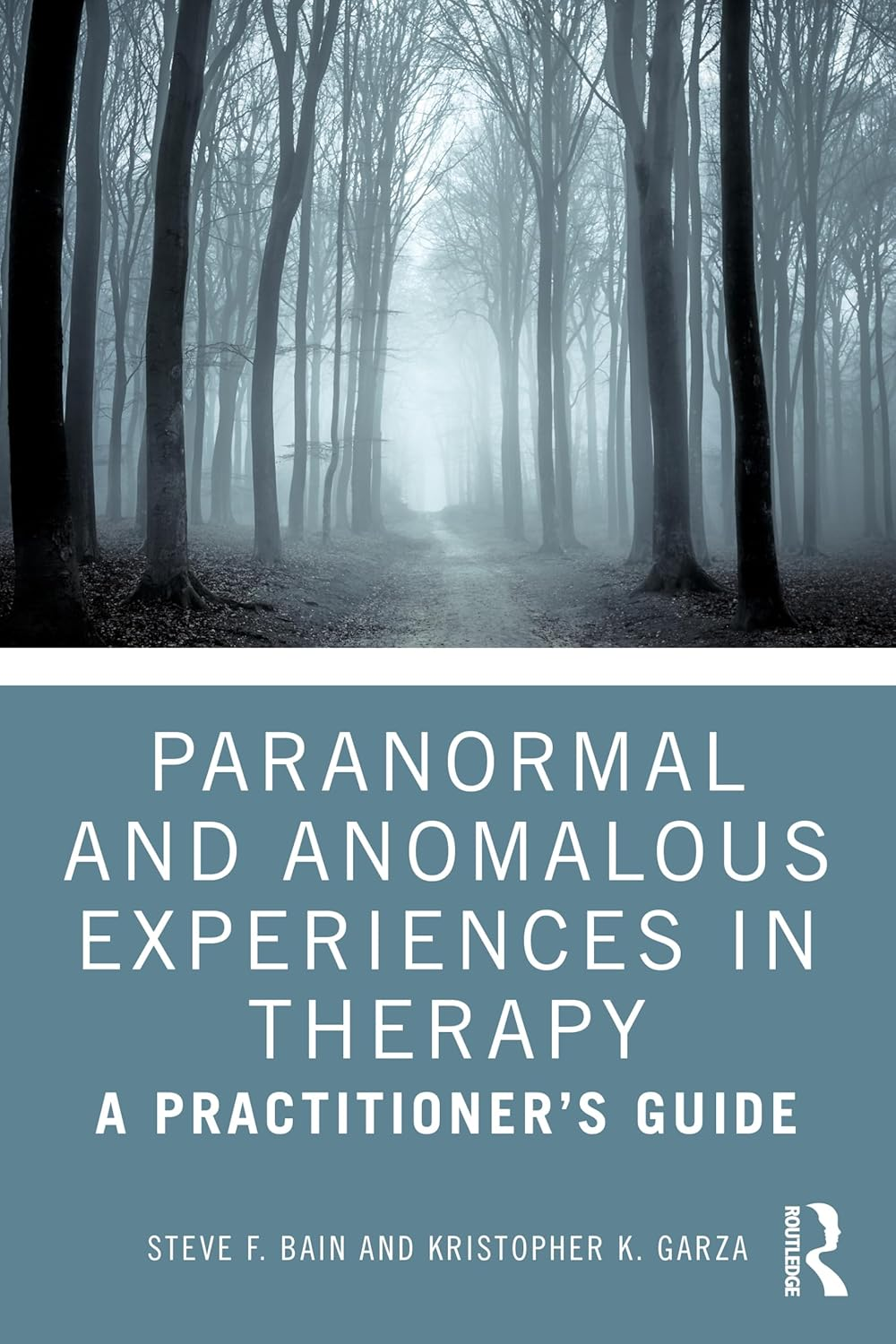
Paranormal and Anomalous Experiences in Therapy: A Practitioner’s Guide by Steve F. Bain and Kristopher K. Garza is the first practical, clinician-focused resource designed to meet this exact need.
This book does not attempt to prove or disprove the paranormal.
It does something far more important.
Not a Debate—A Clinical Imperative
This is not a theoretical treatise or a dense academic volume filled with inaccessible research.
It is a focused, practical, and liberating tool for real-world professionals.
The authors make one position clear: Mental health professionals are not investigators of the paranormal.
They are advocates for the client.
Your role is not to validate the event—but to honor the impact it has on the person sitting in front of you.
A New Standard of Care
At its core, this book provides a roadmap for doing what many clinicians instinctively know is needed—but have never been taught how to do:
Set aside personal beliefs through intentional bracketing
Create a safe, nonjudgmental space for disclosure
Help clients explore meaning, purpose, and identity
Support integration without dismissal or pathologizing
For many professionals, this work is not just helpful—it is freeing.
When the Unexplainable Walks Into Your Office… Be Ready
Graduate training prepares clinicians for many challenges—but not all. And when clients bring experiences that defy explanation, uncertainty can quickly take over.
This book ensures that uncertainty is replaced with clarity, confidence, and ethical direction.
Because the question is no longer whether clients are having these experiences—
it’s whether you are prepared to help them when they do.